

Labourer Resume Template: The Fast, Powerful $2 Upgrade Recruiters Notice
If you’re applying for labouring jobs in Australia, you already know the truth: recruiters scan fast. They want to see your licences and tickets, your site experience, and proof you’re reliable and safety-focused—all in seconds. That’s why an ATS-friendly layout isn’t “nice to have”… it’s essential.
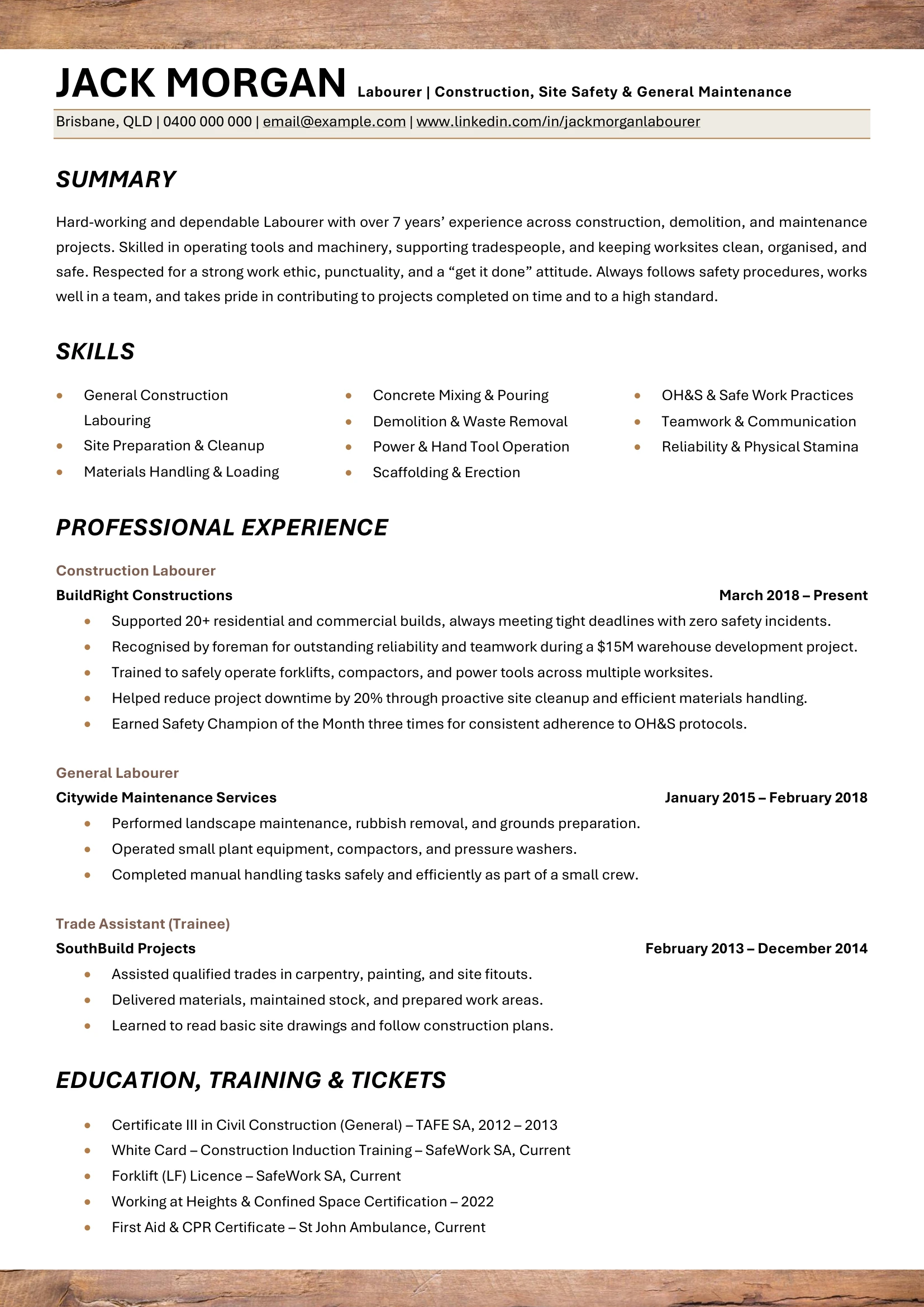
The Labourer Resume Template from ATS Resume is built specifically for trades, labour hire, and construction roles, so the most important details appear immediately (without messy formatting that gets mangled by online application systems). And the best part? It’s $2 for an instant editable DOCX download.
In this blog, you’ll learn exactly what recruiters look for, how this template helps you stand out, and how to fill it in so you can apply with confidence—whether you’ve done residential builds, civil works, demolition, landscaping, maintenance, or trade assistance.
Why labour hire recruiters reject “okay” resumes (even when you’re a great worker)
Labouring roles are competitive, and most employers don’t have time to read every resume line-by-line. Many applications are filtered through ATS (Applicant Tracking Systems) or quickly reviewed on-screen. If your resume is hard to scan, missing tickets, or looks like a giant wall of text, you can get skipped—even if you’ve got the right experience.
Here are the most common reasons solid labourers get overlooked:
- Licences and tickets are buried (White Card, forklift, EWP, confined space, working at heights, high-risk).
- Site experience is vague (no project type, no environment details, no scope, no responsibilities).
- Achievements are missing (no proof of productivity, reliability metrics, or safety performance).
- Formatting breaks in online portals (tables, columns, fancy graphics, or weird spacing that ATS can’t read).
- Too generic (the same resume used for demolition, civil, residential, and maintenance without tailoring).
The goal is simple: make it effortless for a recruiter to say, “Yep—this person is ticketed, dependable, and safe. Interview.” The right template doesn’t replace your experience—it shows it clearly.
What makes this Labourer Resume Template different
This template is designed around what construction and labour hire recruiters scan for first: tickets, safety, reliability, and relevant site experience. Instead of making you guess what to write, it includes prompts that guide you into strong, job-ready bullet points.
1) Licence & ticket summary right where it should be
For labouring roles, tickets are often the first “yes/no” filter. This template makes it easy to list things like: White Card, forklift, EWP, confined space, and other high-risk work credentials so they’re not hidden halfway down the page.
2) Site experience log for fast scanning
Recruiters want to know what kinds of sites you’ve worked on: commercial builds, civil projects, residential construction, infrastructure works, demolition, maintenance, and more. A clear site log helps them connect your experience to their project needs quickly—without digging.
3) Safety and productivity prompts that sound like you’ve done the work
“Hard worker” is nice, but it’s not proof. This template pushes you toward evidence-based bullets—things like: zero harm behaviours, following SWMS/JSA, housekeeping standards, and contributions to efficiency (reducing downtime, preventing rework, meeting deadlines).
4) ATS-friendly formatting that stays readable everywhere
Many flashy resumes fall apart when uploaded to labour hire platforms or contractor portals. This template is built to be ATS-friendly and easy to read on-screen, while still looking professional in Word, Google Docs, or PDF form (when you export correctly).
Who this template is best for
The Labourer Resume Template is ideal if you’re applying for roles such as:
- General labourer / construction labourer
- Demolition labourer
- Civil labourer / road works / infrastructure crew
- Trade assistant (carpentry, plumbing, electrical support)
- Maintenance labourer / grounds and facilities support
- Warehouse labourer with forklift and loading experience
- Labour hire pool roles (multi-site, short notice, fast start)
It’s also great if you’re changing sectors (for example, from maintenance to construction), because the structure makes it easy to highlight transferable skills like manual handling, tool operation, site housekeeping, and teamwork.
How to fill out the template so you get more callbacks
Buying a template is step one. Step two is filling it in with details that match how recruiters think. Here’s a practical way to complete it quickly—without overthinking.
Step 1: Make your tickets undeniable
List tickets using the exact names employers search for. Where relevant, include licence codes and recency (e.g. “Current”). Examples: “White Card (Current)”, “Forklift Licence LF (Current)”, “First Aid & CPR (Current)”.
Step 2: Turn “duties” into “proof”
Instead of “Did site cleanup,” write a bullet that shows impact: “Maintained housekeeping standards to keep access ways clear and reduce hazards, supporting smooth daily operations.” The template prompts make this much easier because they nudge you toward safety and productivity language.
Step 3: Add at least 1 reliability signal per role
Reliability is gold in labour hire. Add signals like: punctuality, consistent attendance, trusted with keys, stayed back to hit deadlines, called up for repeat work. If you have numbers, use them (days without incident, downtime reduction, project value, team size).
Step 4: Use a “mini story” resume pattern
A strong labouring resume reads like: tickets → site types → tools/equipment → safety → results. For example, a fictional-but-realistic set of bullets could look like this (based on common labourer resume content):
- Supported residential and commercial builds while meeting deadlines and maintaining safe work practices.
- Operated forklifts/compactors and handled materials efficiently to reduce downtime and keep crews moving.
- Maintained housekeeping standards and followed SWMS/JSA requirements to support a zero-harm culture.
This style works because it’s easy to scan and it answers the recruiter’s main questions fast.
Real-world example: what a strong labourer summary looks like
A strong summary is short, punchy, and focused on what employers care about. Here’s an example-style summary that fits the kind of language labour hire recruiters respond to:
Hard-working and dependable labourer with several years’ experience across construction and maintenance projects. Skilled in supporting trades, operating tools and machinery, and keeping worksites clean and safe. Known for punctuality, teamwork, and a “get it done” attitude, with consistent adherence to OH&S procedures.
Notice what it does: it puts reliability and safety up front, then supports it with practical skills. That’s the vibe you want to keep throughout the resume.
What you get for $2 (and why it’s worth it)
For $2, you’re getting:
- Instant download as an editable DOCX file (easy to use in Word or Google Docs).
- ATS-friendly formatting built for labour hire platforms and major contractors.
- Guided bullet prompts tailored to safety, productivity, teamwork, and on-site expectations.
- A structure that helps you present tickets + site experience in the fastest possible way.
If you’ve ever missed out on a call-back and thought, “Maybe my resume didn’t show my strengths,” this is a low-cost, high-impact fix. You still do the work—but the template makes sure your work shows up clearly on the page.
Best practice tips before you hit “Apply”
- Match keywords from the job ad (tickets, plant, site types, safety terms) without copying the whole ad.
- Keep bullets tight (aim for 1–2 lines each).
- Use consistent dates (Month Year – Month Year).
- Export cleanly: if the employer asks for PDF, export from Word/Docs and re-check formatting.
- Include supervisor references if appropriate—reliability is often confirmed by referees in this industry.
FAQs about the Labourer Resume Template
1) Is this template good for labour hire agencies in Australia?
Yes. The structure is built around what labour hire recruiters typically scan for first: tickets, reliability, safety, and clear site experience. It’s also ATS-friendly for online systems.
2) Can I edit it in Google Docs?
Yes. It’s delivered as a DOCX file, so you can open and edit it in Microsoft Word or upload it to Google Drive and edit in Google Docs.
3) I only have a White Card—should I still use it?
Absolutely. The template helps you highlight site readiness, safety behaviours, and practical experience. If you’re still building tickets, you can use the structure to show reliability, physical capability, and teamwork.
4) Does ATS-friendly mean it looks plain?
Not plain—professional. ATS-friendly formatting avoids designs that break in application systems. The result is a clean resume that reads well on-screen and prints nicely.
5) How long should my labourer resume be?
For most labourers, 1–2 pages is ideal. If you’ve got extensive site history and multiple major projects, 2 pages is common. The template helps keep information organised so it doesn’t feel cluttered.
6) Should I include “achievements” as a labourer?
Yes—100%. Achievements don’t have to be fancy. They can be safety records, reliability notes, productivity improvements, positive feedback from supervisors, or helping crews meet deadlines. The template’s prompts make this easy.
Ready to apply with a resume that shows your tickets, experience, and work ethic?
If you want a layout that puts your licences, site experience, safety, and reliability in the right places—without struggling with formatting—grab the Labourer Resume Template and start applying today.
Buy the Labourer Resume Template for $2 and download instantly
Tip: After you fill it in, tailor the top third of the resume to each job ad (tickets + site types + key skills). That one small step can seriously lift your call-back rate.


